Design Thinking by Thinking Design
There is a water pot made in Barpali that has not changed much in a very long time. The neck is about a third of the total height. The widest point sits high on the body, around sixty per cent of the way up. Fill it, lift it, carry it on your hip for a kilometre, and you understand why: those proportions are not decoration. They are the answer to a problem about weight, balance, evaporation and the width of a human hand, worked out over generations by people who never wrote any of it down.
I have spent the last year building a platform around objects like that one, and the single most useful thing I have learned is this: the design is already finished. It was finished before I arrived. My job was never to improve it.
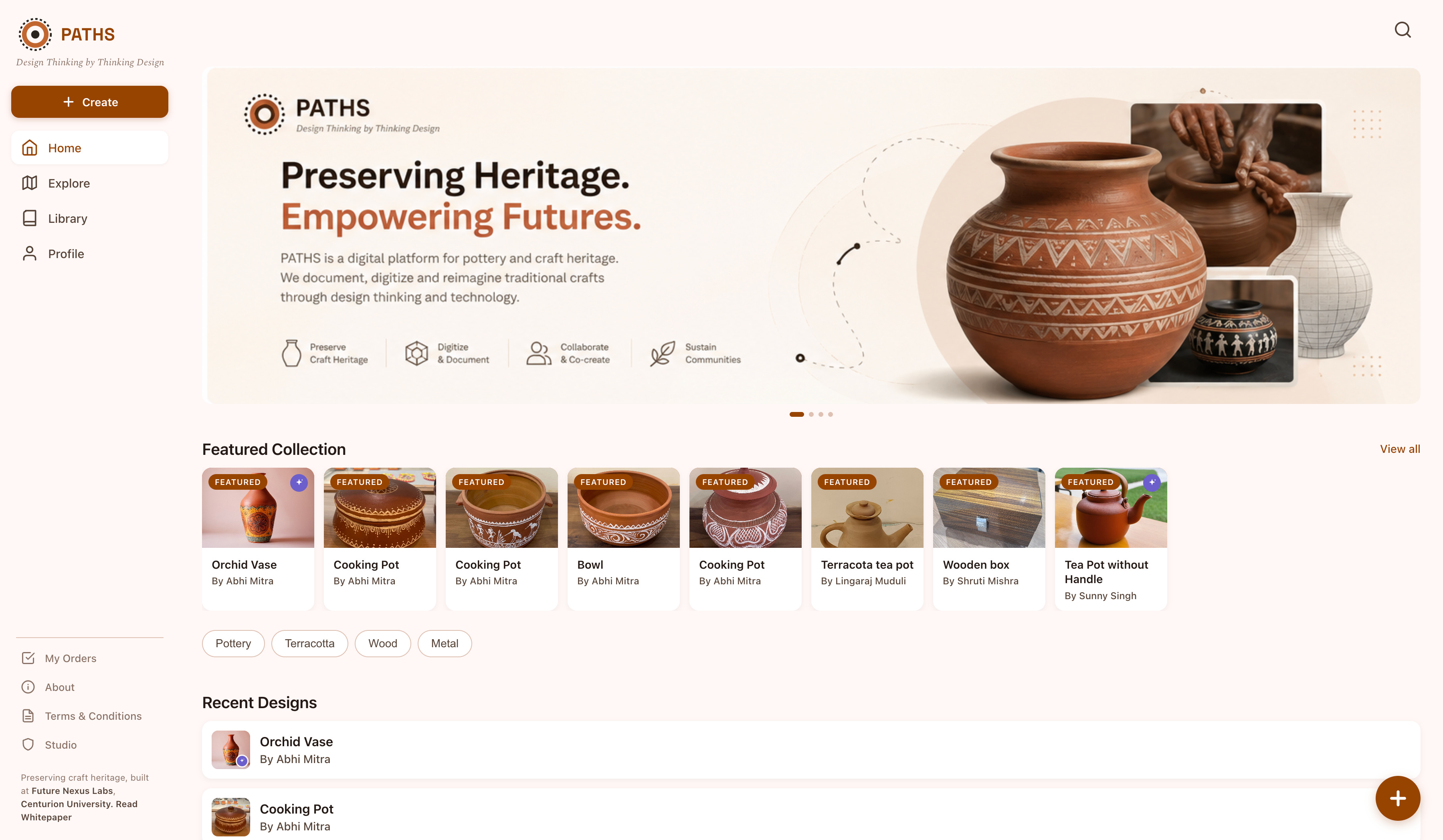
That is what we mean by Design Thinking by Thinking Design — the phrase we ended up putting at the centre of PATHS, the craft intelligence platform we are building at Centurion University in Odisha with Prof. Mukti Kanta Mishra. Design thinking, as it is usually taught, starts from a blank page: empathise, define, ideate, prototype, test. Thinking design starts from an object that already contains a solution and asks a harder question — can you read what is already there precisely enough to extend it without breaking it?
Two ways technology usually fails a craft
When technology arrives in a craft cluster, it tends to fail in one of two directions.
The first is preservation. Someone photographs everything, writes a beautiful report, puts the work in a museum, and the craft becomes heritage in the taxidermy sense — admired, catalogued, no longer earning anyone a living. The potter is honoured and slowly goes out of business.
The second is extraction. Someone shows up with cameras and sensors, records how the artisan's hands move, trains a model on it, and walks away with the skill. The potter gets a small fee and a photograph of themselves in a brochure. What took a family four generations to accumulate becomes a dataset someone else owns.
Both of these are called documentation. PATHS was designed around the belief that there has to be a third option, and that the third option has a specific shape.
Physical → Digital → Physical
The shape is a loop that begins and ends with an object you can drop.
A real pot goes in. Digital work happens in the middle. A real pot comes out — made by hand, by a named person, fired in a real kiln. Nothing about the loop treats the digital artefact as the deliverable. The digital layer exists to do two jobs that craft commerce has always been bad at, and nothing else.
Those two jobs are specification and verification.
Specification is turning a vague request into an unambiguous, dimensioned target that both sides have agreed to before anyone touches clay. Anyone who has commissioned handmade work knows the failure mode: the buyer says "something like this, but a bit taller," the maker makes it, and then there is an argument in which one party is holding an object and the other is holding an expectation.
Verification is the other end — proving that the finished piece matches what was agreed, so the maker gets paid without having to argue for it.
In between those two things is the making. And the making, in our architecture, is untouchable.
Twelve stages, three phases
The loop runs through twelve stages, in three movements.
Capture and ideate. You observe the object and write down what actually defines it. You photograph it to a protocol. You reconstruct it in three dimensions. You build a digital twin — a dimensioned, versioned model that can be measured. Then you begin generating variations.
Reimagine and co-create. The variants are filtered, presented, and worked on together with the buyer and the artisan. This is where a customer gets to say what they want and an artisan gets to say what is possible, in a medium where disagreement is cheap.
Make and validate. One design is ratified — frozen, agreed, priced. Then it is made by hand. Then the fired object is captured again and compared to the thing everyone signed off on.
Stage 09, ratification, is the moment we call the seam. It is where authority and money change hands. Before the seam, everything is negotiable. After it, the specification is a contract, and changing it requires a new one. The artisan is paid at the seam — before materials are committed, not after the piece sells.
The two filters
The part I find most interesting is what happens when you start generating variants of a traditional form.
A computer can generate thousands of shapes from one master model. Most of them are useless, and they are useless in two distinct ways.
Some of them cannot be made. Walls too thin to stand up before they dry. An overhang that collapses on the wheel. A base too narrow for the body above it. A wall thickness that will crack in the kiln because the inside and the outside dry at different rates. We filter these with a test we call φ — a feasibility predicate, which is a formal way of saying what clay, the wheel and the kiln actually permit. A design that fails φ is never shown to anyone. The artisan is never handed an impossible job and then asked why it did not work.
The others can be made and are no longer the thing. Stretch that Barpali water pot far enough and you have a competent vessel that is not a Barpali water pot any more. The proportions that made it recognisable are gone. We filter these with ι — an invariance predicate, checked against what we call the invariant set: the proportion ratios, the motif grammar, the signature features that make a form that form and not another.
Generate two hundred variants. φ removes the ones that will crack. ι removes the ones that have drifted out of the tradition. What survives is usually a small fraction — and that fraction is the point. If the filters ever stopped rejecting things, they would not be filters.
This is what I mean about not inventing the design. ι is only possible because someone sat with an object and wrote down, precisely, what about it was not up for negotiation.
The part where the system refuses
Stages 10 and 11 — the forming and the firing — are what we call the inviolable zone. No automation. No robotic assistance. No system that watches your hands and corrects them.
The important thing is how we enforced it. Not with a policy. Policies get exceptions, usually for a demonstration in front of a visitor. We enforced it by building a system that has no capability to accept delegation of the making. There is no function to call. You cannot grant an exception to a thing that does not exist.
There is an augmented-reality reference available while a piece is being made — the target, anchored at true scale, next to the wheel. It shows you the shape and then it is silent. No guidance, no correction, no score. You look at it the way you would look at a drawing pinned to the wall.
When the piece is fired, we measure it against the twin. And here we had to be careful about what the measurement means. For a student in our skill course, deviation is a grade — they are learning against a target. For an artisan fulfilling a paid commission, deviation is proof of fulfilment, and it may well be their signature. Same number, entirely different question. A handmade object is supposed to deviate. In fact, we flag pieces that match too closely for human review, because a deviation below half a per cent is the anomaly, not the achievement.
Written to be proven wrong
I should be clear about where this stands: PATHS is pre-deployment. We have a framework, a handbook, a skill course going to our Academic Council next month, and a first cohort targeted for January. We have no results, and I am not going to write as though we do.
What we do have is fourteen registered hypotheses, each with a metric and a stated failure condition — the conditions under which we would conclude the approach has not worked. Some of them are deliberately uncomfortable. If the cluster we work with never once exercises its veto over what gets published, we count that as a failure, because a veto nobody uses is exactly what a decorative safeguard looks like from the outside. If the invariance filter turns out to reject nothing, same verdict.
And the central one, which I think is the honest test of the whole thing: we have tried to write this precisely enough that a potter can render its central hypothesis false by putting the tablet down and walking back to the wheel.
If that happens, we were wrong, and it will be worth knowing.
PATHS — Pottery, Art, Technology, Heritage & Sustainability — is being built at Centurion University of Technology and Management, Odisha.
Share this post
Enjoyed this? Get new posts by email