Embracing the Blockchain Journey
- Abhi Mitra
- Jun 9, 2025
- 6 min read

Hello there! I’m Abhi Mitra, and I’m excited to share why I believe blockchain development is an amazing career path—especially if you’re a 2nd-year BTech, BCA, or MCA student starting to explore this field. Think of blockchain as a shared digital ledger or database that many computers (nodes) keep together in sync. Instead of one central authority controlling data, a blockchain stores information in linked “blocks” that are tamper-proof and transparent  . Imagine a ledger or spreadsheet that automatically updates across thousands of computers; once you write something (a transaction) on one “page,” you can’t erase or change it without everyone’s agreement. This makes blockchain secure and immutable, which is why it’s used for cryptocurrencies like Bitcoin, but also in many other areas (finance, supply chains, gaming, and more).
Building Your Foundation
Before diving into blockchain, you need a solid foundation in core computer science topics. Here are the key prerequisites:
Programming Languages & OOP: Be proficient in at least one modern language (e.g. C++, Python, Java, or JavaScript) and understand Object-Oriented Programming. These basics let you write applications and later smart contracts.
Data Structures & Algorithms (DSA): Understand linked lists, trees, hashing, graphs, etc. Blockchains themselves use linked lists of blocks (like a chain), and cryptographic hashing is crucial. Solid DSA skills help you appreciate how data is organized and protected on-chain.
Database Concepts & OS Basics: Blockchain is, at its heart, a database mechanism. So knowing how databases work (transactions, queries, indexing) is important. Similarly, understanding Operating Systems (processes, threads, networking) and Computer Networks helps you grasp how distributed systems coordinate to reach consensus. GeeksforGeeks notes that blockchain developers need knowledge of databases and networking to understand distributed system mechanics.
Internet & Web Technologies: Because most blockchain apps today are Web3 apps (decentralized apps or dApps), familiarity with web development (HTML/CSS/JavaScript) and how the internet works is very helpful. You’ll often integrate smart contracts with a web front-end, using libraries like Web3.js or Ethers.js.
Cryptography Fundamentals: You should know basic cryptography – what hashes, public/private keys, and digital signatures are . These concepts make blockchain secure (cryptography locks blocks and transactions).
“Think of these prerequisites like learning to walk before you run. All blockchain apps are built on top of these fundamentals.”

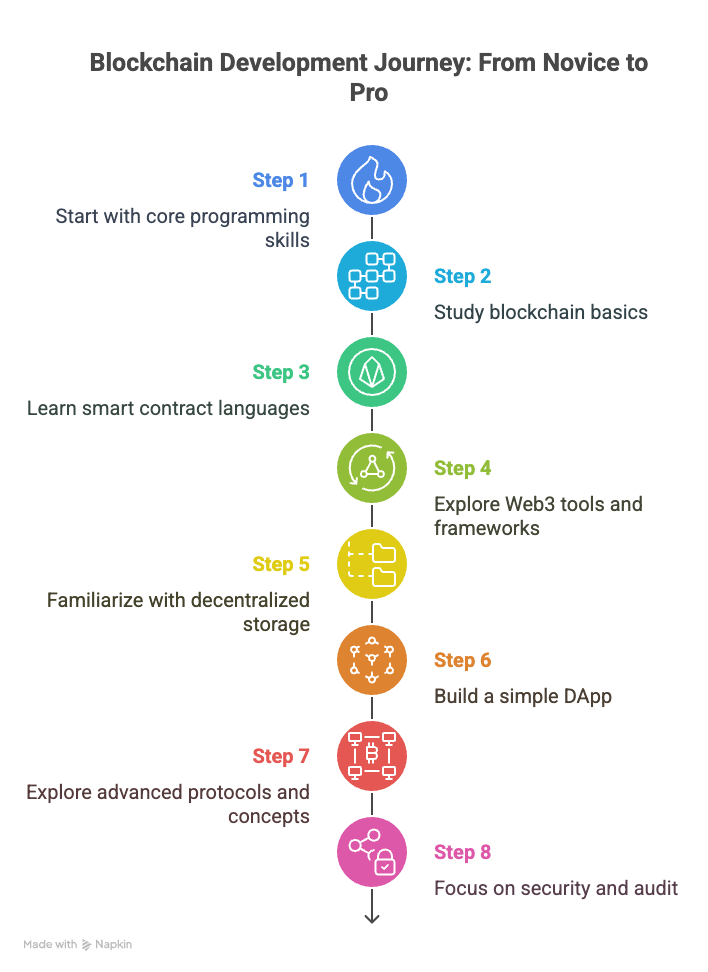
The Blockchain Skill Map: From Novice to Pro
Once you have the foundations, you can follow a step-by-step roadmap into blockchain development. Below is an outline of the skills to learn, in roughly the order you’d need them:
Core Programming Skills – Practice writing clean code in a high-level language like JavaScript or Python. Get comfortable with Git, command line, and basic software engineering practices .
Blockchain Basics – Study how blockchain works: blocks, distributed ledgers, consensus (PoW, PoS, etc.), and peer-to-peer networks. A good mental picture is: “A blockchain is a chain of blocks with cryptographic hashes, shared across many computers” .
Smart Contract Languages – Learn Solidity, the main language for Ethereum smart contracts . Also explore other languages like Rust (used by Solana) or Vyper. Solidity is crucial because Ethereum is the largest dApp platform.
Web3 Tools and Frameworks – Get hands-on with frameworks like Truffle or Hardhat, and libraries like Web3.js or Ethers.js . These help you write, test, and deploy smart contracts and connect your contracts to front-end apps. For example, learning Truffle lets you compile and test contracts easily .
Decentralized Storage & Infrastructure – Familiarize yourself with technologies like IPFS (InterPlanetary File System) for decentralized file storage , and concepts like oracles for bringing real-world data on-chain. Modern blockchain apps often use IPFS to store large data (images, documents) off-chain while keeping proofs on-chain .
Web3 Development (DApps) – Build a simple DApp: a web front-end that interacts with your smart contracts. Use JavaScript frameworks (React, Node.js) and MetaMask or other wallets to connect users to your contract . This ties together your web and blockchain skills.
Advanced Protocols & Concepts – Explore how blockchains scale (layer-2 solutions, sharding, sidechains) and learn about DeFi (Decentralized Finance) and NFTs, which are booming use cases. Understanding different consensus models (PoW, PoS, Delegated PoS, etc.) and smart contract patterns (security, upgradability) will take you from novice to expert .
Security & Audit – Since blockchain involves real value, security is paramount. Learn to test and audit smart contracts (using tools like OpenZeppelin) to find vulnerabilities. This is an advanced, highly valued skill.
By following this roadmap – starting from basic programming and algorithms, then moving into blockchain fundamentals, smart contracts (Solidity), Web3 libraries, and advanced topics – you’ll cover the full skill map of a blockchain developer . Each step builds on the previous one, so you can move at your own pace.

Salaries and Career Prospects
Now, let’s talk real numbers – because knowing the financial upside can be motivating.
In India, blockchain developers earn very attractive salaries. Data from industry sources shows that freshers can start around ₹6–10 lakhs per annum, while experienced blockchain engineers (5+ years) often command salaries in the range of ₹15–30+ lakhs . For example, Indeed reports an average blockchain engineer salary around ₹12.6 lakhs per year in India . Senior blockchain specialists (with 5-7 years of experience) can earn roughly ₹19–20 lakhs or more . Top companies (think Infosys, TCS, Wipro, or fintech startups in Bangalore) may even offer higher packages to secure the best talent .
Globally, the numbers are even higher. In the US, average blockchain developer salaries are on the order of $120k–$180k per year, with top earners exceeding $250k . Web3 salary aggregators also report an average of around $150k globally (with ranges from ~$78k up to ~$262k) . (These figures include base pay plus bonuses and vary by location.) Even in the UK and Singapore, blockchain roles can pay from $75k to $150k USD equivalent . Companies like Coinbase, ConsenSys, IBM, or Google’s blockchain teams routinely pay well for talented blockchain engineers.
It’s worth emphasizing: blockchain skills are in demand and well-compensated. LinkedIn notes that job postings for blockchain roles have grown over 300% since 2019 , creating a skills gap. This competition drives up salaries, often 50–100% higher than comparable software roles.

Job Market Trends and Future Outlook
The blockchain field is still young and growing fast. Key trends to watch:
Massive Adoption: Industries from finance and healthcare to gaming are exploring blockchain solutions. The World Economic Forum predicts that by 2025, more than 10% of global GDP could be on blockchain . In practical terms, that means many established companies need blockchain talent, not just crypto startups.
Job Growth: The U.S. Bureau of Labor Statistics projects that demand for blockchain developers will grow by 22% by 2025, far faster than average for tech jobs . (A similar bullish outlook applies in India: the sector is said to be growing around 47% per year , with aggressive hiring at both startups and big firms.)
Hot Skills (Web3, DeFi, Security): New areas like DeFi (decentralized finance) and NFTs are creating specialized roles (smart contract developers, security auditors, etc.). Companies need people who can build lending protocols, NFT marketplaces, or secure smart contracts. By 2025, professionals who know Solidity, Rust, consensus algorithms, and Web3 frameworks will be especially prized .
Continued Learning: The field evolves rapidly. New blockchains (e.g., Solana, Polkadot, Avalanche) offer novel features, and emerging topics like Web3 identity or tokenomics are hot. But that also means early learners have a chance to grow with the technology.
For Indian students, this means timing is great. India is investing heavily in blockchain tech, with major IT companies (Infosys, TCS) and startups (Polygon, WazirX, etc.) all active. The demand for blockchain-savvy graduates is rising, often above traditional IT roles . Globally, even amid economic slowdowns, blockchain and crypto startups continue to hire, and many companies (financial, tech, gaming) are keeping their blockchain projects hot.
“In short: the future looks bright. Learning blockchain now means stepping into a growing market with high demand and salaries.”


Resources: Videos & Learning Paths
To get started, there are plenty of beginner-friendly tutorials online. For example, Simplilearn’s “What is Blockchain?” video (around 13 minutes) gives a concise, visual introduction to how blockchain works. IBM Think Academy’s “Blockchain Technology Simply Explained” is another great watch, breaking down core concepts in plain language. (Both are easily found on YouTube.) For a deeper dive, the Edureka channel has an “8-hour Blockchain Developer Full Course” that covers everything from fundamentals to smart contracts – a marathon, but very comprehensive.
Whenever you watch these, try to apply what you learn: install an Ethereum development environment like Hardhat, write a simple Solidity contract, and interact with it via a web app. Hands-on building is the fastest way to solidify concepts.
Start Your Journey Today!
Entering the blockchain domain early can set you apart. Start by polishing your coding and CS fundamentals this year, then slowly layer in blockchain concepts. Build toy projects – even a simple “Hello Blockchain” smart contract – to gain confidence. Join hackathons, follow communities (Discords, GitHub), and never stop learning.
Blockchains won’t disappear overnight; they’re being adopted by more industries every year. As Abhi (that’s me!) likes to say: “Get ahead of the curve now.” With dedication and the right prep, you could be among the first in your class to land a blockchain internship or open-source contribution. And that experience will be gold when recruiters see your resume.
Remember, this is a marathon, not a sprint. Take it one step at a time: learn programming, understand blockchain basics (how blocks link, what consensus means), then build your first smart contract. Each skill you acquire will reinforce the others .
So stay curious, stay motivated, and start coding! Your future self – with that coveted blockchain developer job – will thank you.


Comments